An enemy in the cave
Scientists who study bats have unwittingly become detectives happening the trail of a troubling mystery.

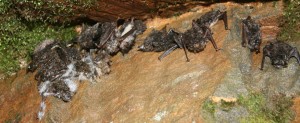
It began during the overwinter of 2006. A visitor exploring a cave warm Albany, N.Y., photographed asleep bats. He noted they looked odd, because their noses were covered in gothic, white fuzz — a caboodle like the fuzz on a moldy talk.
The following winter, other hoi polloi began noticing troubling signs at close caves: Bats were running around aimlessly in broad daylight, probably in search of food. Normally the bats would be roosting (close closely put together) in place wholly winter.
And so, in March 2007, researchers came upon a scene straight out of a nightmare. They stumbled onto thousands of bat skeletons disordered crossways the ball over of one of the caves. The previous spring, bonkers here had been plump, healthy and thriving.
In short order, biologists would find this morbid scene at caves and mines passim the Northeastern Federate States. And forever on that point was the incomprehensible white blur clinging to the bats' ears, wings and muzzles.
Its spread was rapid. By 2010, the scourge had reached Canada to the north and as far in the south as Tennessee.
This unwellness, known as white-nose syndrome (WNS), is now crawling due west. Information technology has leapfrogged to caves and mines 800 miles from its fresh locate. Indiana was recently confirmed to have WNS, and the disease is suspected to rich person reached as far south and west As Oklahoma.
At least sixer of the 45 species of bats in North America birth been hit with white nose out — including the little brown bat and the endangered Indiana cricket bat (also found external the state). Scientists estimate that more than a million whacky have died, and perhaps farthermost more than that.
The apparent culprit is a fungus known as Geomyces destructans. Unlike the fungus that thrives on sweaty feet and causes jock's foot, this one prefers chilly, moist spots like the caves and uninhibited mines where bats hibernate. Researchers assume't quite understand why the fungus makes bonkers sick, but scientists are racing to pile up as many clues as practical to try and thwart the disease. Their best hope is to slow the spread of the disease between caves and across the country. Ultimately, scientists are working to prevent mass extinctions of bats — or their permanent loss.
Team players
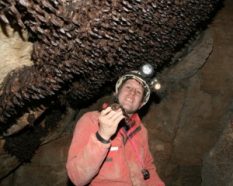
Bats are "non charismatic, they're non big and furry, but they are beautiful little animals," says Hazel Barton, a cave microbiologist at Northern Kentucky University in Highland Heights. But she thinks it's hard for many the great unwashe to care about bats' survival of the fittest "because they don't realize how important of a role [bats] play."
Whacky broadcast seeds and pollinate flowers. They reuse key nutrients, pooping out natural fertilizers that benefit soils and spelunk ecosystems. And they provide critical environmental services to people by feeding insects responsible for many crop and forest diseases.
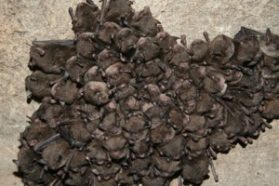
A single hibernation site can represent home to anywhere from dozens to hundreds of thousands of bats. In some instances, 100 to 150 bats May squish into an area the size of a Frisbee. Bats sometimes hang side by side, forming thick, furry carpets happening the walls and ceilings of caves and mines. When researchers descry the talebearer blur on hibernating bats, they know the animals' future is grim. In sites where insane are afflicted with WNS, up to 99 percent (or, 99 in 100) of the bats will probable conk.
"We call them zombies because they're releas to be utterly by the remainder of the temper," says Barton. "It feels same death is there visiting."
Descending dominoes
Since WNS arrived, the lives of clobber researchers own been tough. The bad is when you go back to caves where healthy insane had lived year after year, says Gregory Turner. He's an endangered-mammal specialist with the Pennsylvania Game Delegation.
In one Pennsylvania cave, researchers had come to recognize a tiny tricolored bat that hung onto the same rusty nail all winter long for at the least 15 years. But in 2010, this bat went missing. And it wasn't just that bat that went lacking. Of some 2,800 wacky that once lived in the cave, the researchers found entirely 35 that season.
So far, WNS seems to be affecting only dormant bats. Researchers suspect this may provide an important clue to how the fungus gets a foothold.
During hibernation, bats rest just a couple of times an hour. Their metabolism, surgery DOE yield, drops into slow move. And their immune systems, which fight infection and illness, are connected intermit. "They're impartial sort of in cold storage," says DeeAnn Reeder, a bat life scientist at Bucknell University in Lewisburg, William Penn. "Normally that deeds just fine for them." But so "along comes this cold-loving fungus that happens to grow best when the animals have no condition competence."
Healthy bats emerge from hibernation for only about an hour or deuce — something called an arousal — once all two weeks. Researchers believe that round the bend with WNS may be arousing from hibernation besides frequently. Each time bats call fort, they have to rev up their metamorphosis, kinda like warming up a car or rebooting a computer. This process Burns precious fat reserves that the crackers need to get done the winter. Equally a lead, bats become unco peckish, and the search for food whitethorn be why they leave their caves early. But during the winter, they obtain few insects. This continual disturbance depletes their Department of Energy reserves. And over time, scientists now believe, this causes the bats to starve to death. They May be too thin to reproduce when spring arrives.
The fungus also erodes the bats' wings, turning them into something resembling cheesecloth, thin and with small holes. So bats that arrive through the winter may still be impotent to fly fountainhead enough to catch food.
"There are probably fivefold things happening that are having a half mask effect," says Reeder. "We're just nerve-racking to lick what all those dominos are and how they all relate."
Unwished visitor
Scientists aren't sure how G. destructans got hither. It Crataegus laevigata deliver hitched a ride to the United States from Europe, probably on the clothes or shoes of someone who went into a cave. Indeed, the fungus appears identical to a fungus that lives in Common Market. Just bonkers in Europe thus far seem to be sun-loving. And that makes researchers suspicious that European bats may have developed a resistance to the fungus lang syne.
North American country bats represent a New Globe (Hesperian Hemisphere) population, says Barton, and the fungus constitutes an Old World (Continent) disease. Its comer in the United States of America is probably much like when European settlers arrived in America, bringing smallpox. Autochthonal Americans had never been exposed to variola major, which turned dead set be very lethal to them.
"I don't think there's any difference 'tween what happened then and what we're seeing with the bats," Barton says. "The Unused World-wide population had nobelium resistance, IT had never been unprotected to the being before, and as a result there was high mortality."
White-nose syndrome highlights how little we know nearly germs like bacteria and fungi, says Saint David Blehert, a microbiologist (someone who studies little organisms) with the United States Geological Survey's Political unit Wildlife Health Center in James Madison, Wis. While IT's rare for scientists to discover new species of mammals or birds, he explains that "the microbial world-wide is still 99 per centum inglorious to science."
"Caves that bats hibernate in are fair absolutely gas-filled of brothers and sisters and cousins of this fungus that are very closely related — but as yet somehow different," Blehert adds. "Understanding those differences wish be paint to understanding wherefore this united [microbe] is so rotten."
Researchers do not however understand how white nose spreads. Just if they give the axe't watch how to stop it in its tracks, it could prove catastrophic for farmers and forest managers.
In summer and early fall, bats gorge on insects. A female bat can eat 4,500 insects in a single night, or much 100 percent of her body weight. "That's like me going out and having 500 stern-pounders nightly," says Reeder. Bats feast on hoards of insects in order to store up fat for the wintertime.
Experts idea that the loss of one billion bats represents 700,000 tons of uneaten insects each summer. So "hundreds and hundreds of tractor trailers full of insects that would have been appropriated verboten by the bats" are now sticking around, says Barton. Many of these are agricultural pests, such as moths, that munch connected food crops and cotton. To cope with the going of bats, farmers may feel nonvoluntary to habit more pesticides, which would lead to an increase in air and water pollution.
Researchers are working feverishly, but so faraway have got known no means to stop the spread of white pry. "The efforts right instantly to find something to treat the bats or to prevent the fungus from healthy are more of a Band-Aid than a cure," says Turner.
Stalking the opposition
At a handful of sites, researchers are attempting to pop the fungus by scattering a variety of natural chemical compounds in winter-hibernating bat colonies. Merely preliminary data suggest that the treatment may be toxic to the whacky too. And because bats live in complex ecosystems, researchers must also call up or so other beneficial organisms that could be affected by the handling.
"We could spray the bats with an antifungal that mightiness kill the gabardine nose, but then it might drink dow everything else in the undermine that the bats need to outlive for the long terminal figure," says James Eggers. He directs preservation programs at Chiropteran Conservation International, settled in Austin, Texas. "We require to find something that can specifically place this one fungus and non effort damage to other essential fungi."
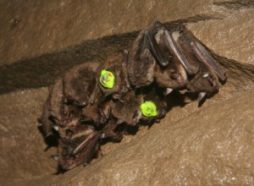
One way that researchers study hibernating bats without disturbing them is by gluing bantam information loggers that resemble M&M's onto the balmy' backs. The loggers immortalize the temperature of the bats' skin and tell researchers how ofttimes the round the bend are arousing from hibernation.
Bat biologists suspect that insane living in colder hibernating colonies might have an advantage finished those in slimly warmer ones. So, in a handful of sites, researchers hope to experiment with creating microclimates (steady climate conditions in a small domain) by altering temperature and humidity. This approach might be effective in bound states, such as Pennsylvania, where 90 percent of bats hole up inside abandoned mines. (It would be inappropriate for researchers to qualify the climate of caves, which contain very complex natural ecosystems.)
"There are days that I feel like we'atomic number 75 doing everything we can and we'Ra just documenting an extinction," says Reeder. Quieten, she sees board for hope.
"The only thing I know how to do is stick my nose to the grindstone and just work," she says. "Hopefully, somewhere in that process we can come up with some information that will allow us to stop this [disease] and understand what's going along."
Power Words (adapted from Yahoo! Kids dictionary):
arouse: The brief time when animals issue from sleep surgery hibernation. Bats now and then go forth from hibernation and bring their body temperature up to virtually 100 degrees Fahrenheit for combined or two hours. Then the bats drop vertebral column into hibernation, and their bodies return to the surrounding temperature, usually about 45° F.
ecosystem: The organisms and environmental elements (such atomic number 3 rocks and ground) of a shared area.
fungus: Any of galore organisms in the Fungi. They lack chlorophyl (used in photosynthesis) and vascular tissue (like blood in animals and sap in plants) and range in form from a single mobile phone to a body mass of branched, threadlike structures. The kingdom includes yeasts, molds, smuts and mushrooms.
hole up: To be temporarily dormant, surgery quiescent, usually during the winter.
microclimate: The clime of a small, specific lay out within an area as compared with the climate of a all-inclusive region.
pollinate: The transfer of pollen (a fine substantial exploited in angiosperm reproduction) from an anther (the male partly of a flower) to the stigma (the female part of a flower).
roost: A place to temporarily eternal sleep or eternal rest.
speleology: The scientific study or exploration of caves.
0 Response to "An enemy in the cave"
Post a Comment